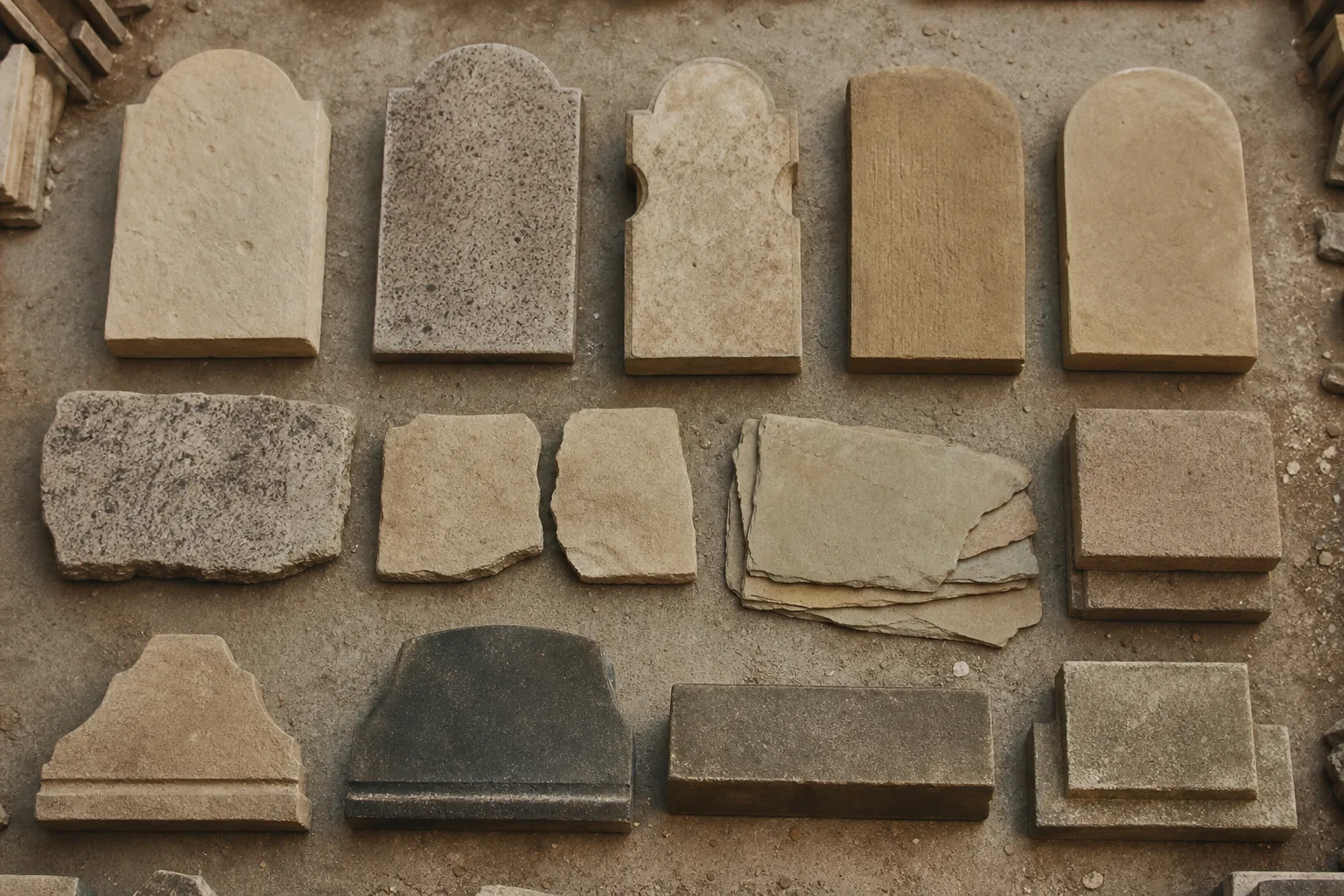
In a churchyard in the older part of a county seat, two markers stand about eight feet apart, and both were cut in the 1870s. One is white marble, and nothing on its face can be read from a standing position: the surname survives as a shallow trough, the dates are gone, and the carved dove at the top has lost its beak and most of one wing. The other is dark gray granite, and the lettering is crisp enough to read at a walking pace, including the small stonecutter's mark near the base. Same weather, same soil, same century. The difference was decided at the point of sale.
Why marble and sandstone go blank and granite does not
Marble is calcium carbonate, and rainwater carries enough dissolved acid to take it into solution, slowly and evenly, across the whole exposed face. The loss is not damage in the sense of a chip or a crack. It is the surface retreating a fraction at a time, and since incised lettering is only a fraction deep to begin with, the inscription disappears before the stone does. Sandstone fails differently, by shedding in sheets along its bedding planes, so the face spalls away and takes the carving with it. Granite is quartz and feldspar, and both resist acid, which is why the 1870s granite is still legible.
A careful reader can check this without any technical knowledge at all. Walk the older section of the burial ground you are actually buying into, find markers from a period you can date by the inscriptions, and look at which materials are still readable. Local air, local rainfall and local tree cover all matter, and the churchyard has already run the experiment. The National Institute of Standards and Technology is the federal body responsible for materials measurement and testing standards, and stone weathering sits inside that remit, but the row of stones in front of you is the more useful evidence.
Polish loss, lichen and the slow tilt
Granite's endurance is not the same thing as its appearance staying fixed. A mirror polish is a mechanical finish, produced by progressively finer abrasives, and it dulls on the faces that take the most sun and the most rain, usually the top and the south side. Fifteen or twenty years in, a polished black granite may read as charcoal rather than mirror, particularly where a sprinkler head throws hard water at it. Lichen colonizes rough surfaces far faster than polished ones, which is why the sawn sides and the unpolished top of a rock-pitched stone gray over first. None of this affects legibility, and both are reversible with careful cleaning.
Sinking and tilting are foundation problems, not stone problems. A marker set on a shallow concrete pad in soil that freezes will move, and a tall die on a narrow base will move visibly. Ask what foundation the cemetery requires and who pours it, because in many burial grounds the cemetery pours the foundation itself and charges separately for it, and that specification is the thing you should be reading, not the dealer's brochure.
What sits behind a bronze plaque
Bronze markers are cast plates, typically mounted on a granite base, and they develop a dark patina that most families come to like. The part worth checking is the backing. Some plaques are set on an aluminum backing plate, some on cast bronze frames, and some cheaper markers are aluminum throughout with a bronze-toned finish, which is a different product with a different service life. Ask what alloy the plate is, what the backing is made of, and how it is anchored to the granite base. Ask, too, who is responsible for reseating it if the anchors loosen.
Why one granite costs twice another
Granite pricing tracks supply, not durability. Common grays and dark blacks are quarried in large, reliable volumes, and a dealer can source them in almost any size without waiting. Reds, blues, greens and the strongly figured stones come from fewer quarries, sometimes only one, and the usable yield from a block is lower because the color has to run consistently through the whole slab. Add ocean freight, add the risk of a color the dealer cannot match if a companion stone is ordered a decade later, and the premium becomes arithmetic rather than fashion.
Ask for the trade name of the granite, not just the color, and write it on the order. If a spouse's matching stone is ordered in twenty years, that name is what makes the match possible.